
AI’s Next Test: Who Pays the Bills?
Artificial intelligence may transform the economy, but an exciting technology does not automatically make every related investment attractive. Heavy spending, borrowing and ambitious expectations can create financial vulnerabilities.
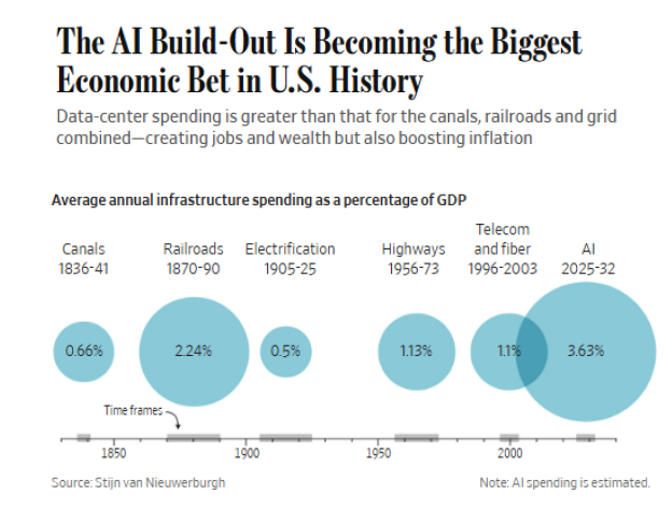
Source: The Wall Street Journal; data from Stijn Van Nieuwerburgh, “Financing the AI Buildout,” Brookings Papers on Economic Activity, Fall 2026. AI spending is estimated.
Our research partner Hedgeye Risk Management has created an AI Risk Dashboard which objective is to allow investors to access the risk of being exposed to the AI related sectors. It has identified 11 triggers or warnings. This dashboard gets updated weekly.
AI companies are building costly infrastructure before customer revenues can fully support it.
Think of AI spending as building a vast new railway before knowing how many passengers will buy tickets.
The markets will ultimately give us warnings.
One warning or trigger comes from corporate bonds. Hedgeye reports that the additional interest investors demand from lower-rated borrowers increased by 0.59 percentage points over the past month. Hedgeye Early look October 15, 2026. This “credit spread” typically widens when investors become more worried about repayment. AI
That matters because data centers require enormous spending on chips, electricity, buildings and cooling. According to Hedgeye, Oracle’s infrastructure spending is roughly twice its operating cash flow, while CoreWeave’s exceeds four times. Hedgeye Early look October 15, 2026. Both therefore depend on outside financing.
Some cloud companies also invest in AI developers that then purchase their services. These connections can support growth, but financial trouble at one company could spread to others.
The dashboard previously identified vulnerabilities without confirmed immediate warning signals. Newer market stress deserves attention, although it does not make a crash inevitable.
At Red Barn, “Think Further” means examining how growth is financed. Diversification, financially resilient businesses and disciplined risk management help protect retirement income and wealth intended for future generations. Investors should also consider overlapping AI exposure across stocks, broad market funds, corporate bonds and private investments.
Source: summarized commentary from Hedgeye Risk Management any figures are unverified. General information only, not personalized investment advice.
Disclaimer: For general informational purposes only and not investment advice.
The table below reflects trend signals published by Hedgeye Risk Management as of October 15, 2026.
These signals are one input among many considered by our investment team and may not align with positioning in any client portfolio. Individual securities and commodities referenced may not be suitable for any particular investor. Clients should not act on this information without consulting their portfolio manager.
Tactical Trend Changes📈
Technical trends are analytical observations and do not guarantee future results
Japan…………………..Bullish to Neutral
Copper…………………Bullish to Neutral
Semiconductors……..Neutral to Bearish
Consumer StaplesBearish to Bullish
Bullish: a view that the price of a security or market may rise, subject to significant uncertainty and risk of loss. Bearish: a view that the price may fall, subject to significant uncertainty and risk of loss. Neutral: a view that the price may remain relatively stable. These terms reflect third-party and/or general market views and are not recommendations or predictions.