
Interest Rates
This week, on July 28th, the the US Federal Reserve announced that it will not change the overnight interest rate.
This is the interest rate banks charge each other to borrow reserve balances. When people say “the Fed raised rates” or “the Fed cut rates,” they usually mean the Fed changed this target range.
It matters because it influences many other short-term rates across the economy, including savings rates, loan rates, floating-rate debt, and eventually longer-term borrowing costs.
What the Bond Market May Be Telling Investors
The bond market does not always get as much attention as the stock market. Stocks tend to dominate the headlines because they are easier to follow and more familiar to many investors.
But if you want to understand where the economy, inflation, and interest rates may be headed, the bond market is worth watching closely.
In many ways, bonds can act like an early warning system. Bond investors are constantly weighing inflation, economic growth, central bank policy, government borrowing, and recession risk. Because of that, bond yields often move before the broader economy fully shows the change.
That does not mean the bond market is always right. No market has a perfect crystal ball. But bond yields can provide useful clues about what investors are expecting next.
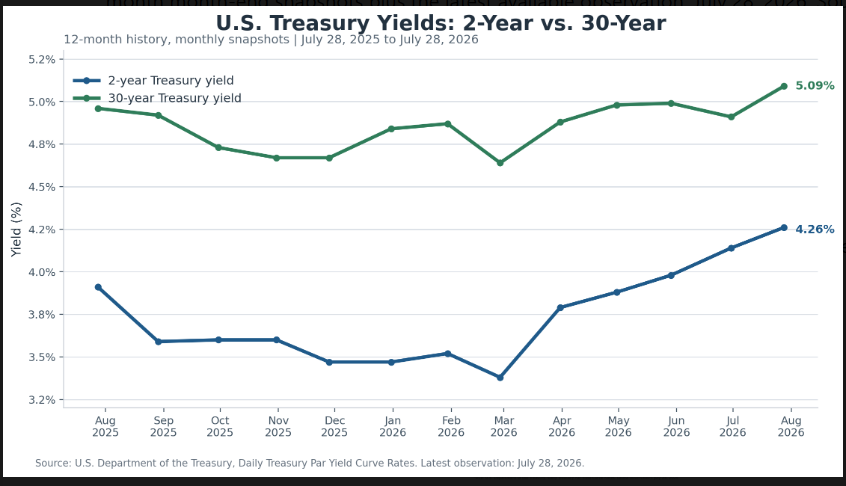
What is the chart telling investors about the economy and inflation?
The chart shows that long-term borrowing costs stayed high throughout the year, with the 30-year Treasury yield remaining near 5%.
The 2-year yield fell through late 2025 and into early 2026, suggesting investors were expecting lower short-term interest rates.
By spring 2026, the 2-year yield began rising again, which suggests investors became less confident that rate cuts would happen quickly.
The 30-year yield also moved higher into mid-2026, which may point to ongoing concern about inflation, government borrowing, or long-term economic uncertainty.
The gap between the 2-year and 30-year yields stayed wide, showing that investors wanted extra compensation for lending money over many years.
The main message for investors: the bond market is not signaling a collapsing economy, but it is still warning that inflation and long-term borrowing costs remain important risks to watch.
Its not all about the economy
A well-constructed portfolio should not rely only on the economy or public markets as its main source of return.
Many pension plans also invest in assets with return drivers that are less directly tied to stock and bond markets. These are often called alternative investments.
One example is a music royalty fund.
A music royalty fund earns income from royalties generated when songs are streamed on platforms such as Spotify and Apple Music. In simple terms, the return is connected to music usage and royalty payments, rather than only to economic growth, interest rates, or stock market performance.
This does not mean alternative investments are risk-free. They can be less liquid, harder to value, and may not be suitable for every investor. But used thoughtfully, they can add another source of potential return and diversification within a broader portfolio.
If you would like to learn more about a music royalty fund , please feel free to reach out or:
The table below reflects trend signals published by Hedgeye Risk Management as of July 31, 2026.
These signals are one input among many considered by our investment team and may not align with positioning in any client portfolio. Individual securities and commodities referenced may not be suitable for any particular investor. Clients should not act on this information without consulting their portfolio manager.
Tactical Trend Changes📈Technical trends are analytical observations and do not guarantee future results
Japan…………………..Neutral to Bearish
Germany………………Bearish to Neutral
Oil WTI,,,,,,,,,,,,,,,,,,,,,,,Neutral to Bullish
Consumer Staples…..Neutral to Bullish
Bullish: a view that the price of a security or market may rise, subject to significant uncertainty and risk of loss. Bearish: a view that the price may fall, subject to significant uncertainty and risk of loss. Neutral: a view that the price may remain relatively stable. These terms reflect third-party and/or general market views and are not recommendations or predictions.