
Canadian Productivity
Canada’s Productivity Gap: A Headwind for the Canadian Dollar?
Canada’s widening productivity gap with the United States could be one reason the Canadian dollar has remained relatively weak.
Currencies are influenced by many factors—including interest rates, commodity prices and capital flows—but over the longer term, productivity and economic competitiveness matter. And on that front, Canada has been losing ground.
A recent Fraser Institute report found that Canadian GDP per capita trailed the U.S. by approximately $10,766 (Canadian dollars) in 1999. By 2024, the gap had more than doubled to $23,757.
The Productivity Problem
Between 1999 and 2025, U.S. labour productivity increased 67.9%, compared with only 26.7% in Canada.
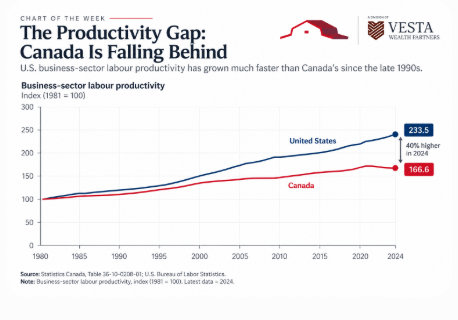
Prepared and Retrieved September 08, 2026
Business investment tells a similar story. In 2007, Canadian businesses invested about 90 cents per worker for every $1 invested in the U.S. By 2024, that had fallen to just 54 cents.
Lower investment in technology, equipment and productive capacity can mean slower economic growth, weaker wage gains and less competitive businesses. Over time, those differences can also make a country less attractive to global capital—potentially creating another headwind for its currency.
What Does This Mean for Investors?
Canada remains home to many excellent businesses, but the productivity gap reinforces the importance of looking beyond our borders.
The U.S. market provides significantly greater exposure to technology, artificial intelligence, automation and other areas attracting substantial investment and driving productivity growth.
For Canadian investors, a weaker Canadian dollar can also increase the Canadian-dollar value of U.S. investments—although currencies can move in either direction.
The takeaway: Diversification isn't simply about owning more investments. It's about gaining exposure to different economies, currencies, industries and sources of growth.
Source: Wealth Professional Canada, Steve Randall, September 1, 2026; Fraser Institute, Squandering the Canadian Century – Part 1.
For general information only and not individualized investment advice.
The table below reflects trend signals published by Hedgeye Risk Management as of September 3, 2026, 2026.
These signals are one input among many considered by our investment team and may not align with positioning in any client portfolio. Individual securities and commodities referenced may not be suitable for any particular investor. Clients should not act on this information without consulting their portfolio manager.
Tactical Trend Changes📈
Technical trends are analytical observations and do not guarantee future results
Japan…………Neutral to Bearish
China…………Neutral to Bearish
Natural Gas…Neutral to Bullish
Bitcoin……….Neutral to Bullish
Bullish: a view that the price of a security or market may rise, subject to significant uncertainty and risk of loss.Bearish: a view that the price may fall, subject to significant uncertainty and risk of loss.Neutral: a view that the price may remain relatively stable. These terms reflect third-party and/or general market views and are not recommendations or predictions.